
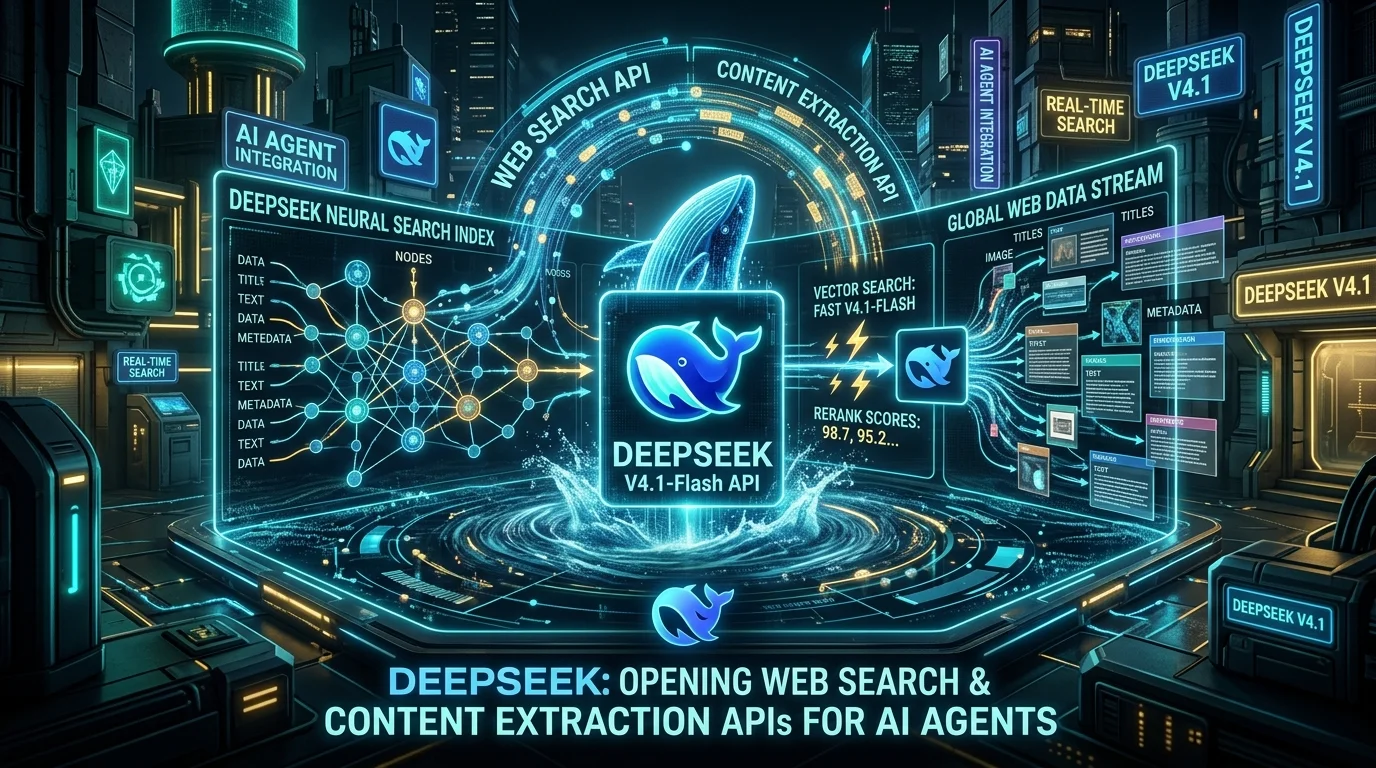
Executive Thesis: The general availability of DeepSeek's Web Search (/search) and Content Extraction (/fetch) APIs, anchored by its in-house search index and paired with the DeepSeek-V4.1-Flash model, represents a structural turning point in software development. Priced at an aggressive 0.75 US dollars per 1,000 queries, DeepSeek challenges not only traditional search behemoths like Google and Bing, but fundamentally disrupts specialized search aggregators for AI agents such as Tavily and SerpAPI. By delivering semantically reranked web documents and structured Markdown parsing as first-class cloud primitives, engineering teams can build real-time Web RAG agents without managing brittle scraping clusters or paying exorbitant search tolls.
🔍Introduction: The Structural Bottleneck of Static AI Knowledge
Over the last two years, software engineering teams deploying autonomous agents repeatedly crashed into a foundational wall:the static knowledge cutoff of neural network weights. Regardless of how advanced a foundation model is (whether GPT-4o, Claude 3.5 Sonnet, or Gemini 1.5 Pro), frozen parameters are inherently blind to breaking news, real-time stock volatility, freshly committed open-source documentation, or live product inventory states.
To circumvent this limitation, the industry converged aroundWeb Retrieval-Augmented Generation (Web RAG). Yet implementing Web RAG until now was an operational ordeal. Developers were forced to assemble fragile multi-vendor pipelines: expensive search API subscriptions (Google Custom Search or Bing Web Search), residential proxy networks to evade bot detection, headless browser clusters running Playwright to parse messy DOM trees, and token-heavy cleanup scripts to sanitize raw HTML before feeding context to the model.
DeepSeek's release of its dedicated Web Search and Fetch APIs fundamentally redesigns this developer experience. By combining an in-house web crawler, continuous semantic relevance scoring, automated clean Markdown extraction, and the ultra-efficientDeepSeek-V4.1-Flashmodel, DeepSeek turns real-time web awareness into an accessible, commodity primitive.
⚡1. Inside DeepSeek's Web Suite: Search, Extraction, and V4.1-Flash
The platform delivers two complementary primitives engineered explicitly for machine consumption and autonomous agent workflows:
The Structured Search API (/search):Accepts standard natural language queries or boolean operators (site:, -site:, quoted phrases) and returns ranked results featuring an explicitrerank_scoreranging from 0 to 3 (scores above 1.5 denote high authority and freshness). It supplies both a brief snippet for UI presentation and a dense 600-to-800 character summary crafted for optimal LLM context packing.
Content Extraction Primitive (need_content: true):When an agent requires in-depth reading of target articles, toggling theneed_contentparameter automatically fetches the remote page, strips ads, boilerplate navigations, and tracker scripts, delivering clean, semantic Markdown directly within the API response.
The High-Throughput Engine: DeepSeek-V4.1-Flash.To process web extracts with minimal latency, DeepSeek upgraded its V4.1-Flash model (accessed as deepseek-flash). Utilizing an asymmetric Mixture of Experts (MoE) architecture activating only 8B parameters on input and 16B on output, it features an extraordinarily small KV cache memory footprint. This makes high-volume multi-turn document synthesis exponentially cheaper and faster than general-purpose frontier models.
💰2. Disruptive Economics: US$ 0.75 per 1,000 Queries vs. Incumbents
Search API economics have long constrained startup agent architectures. Legacy search providers designed their billing models around corporate search bars or enterprise marketing intelligence, pricing queries out of reach for autonomous agents executing multiple research cycles per prompt.
| Provider / Service | Price per 1,000 Searches | Native Content Extraction | Continuous Reranking Metric |
|---|---|---|---|
| DeepSeek Search API | US$ 0.75 (promotional tiers available) | Yes (semantic clean Markdown) | Yes (continuous rerank_score 0 to 3) |
| Tavily Search API | US$ 5.00 to US$ 8.00 | Yes (LLM-optimized extracts) | Yes (AI search optimization) |
| Bing Web Search API (Azure) | US$ 3.00 to US$ 7.00 | No (requires external scraper) | Basic (web ranking order) |
| Google Custom Search JSON | US$ 5.00 (hard 10k query daily cap) | No (returns brief snippets only) | No (standard PageRank index) |
| Brave Search API | US$ 3.00 to US$ 5.00 | Partial (rich snippet extracts) | Basic (independent index) |
At 0.75 dollars per 1,000 calls, DeepSeek undercuts established market alternatives by 4x to 10x. For a production platform running 100,000 automated research queries monthly, infrastructure costs collapse from roughly 800 dollars on legacy aggregators to just 75 dollars on DeepSeek.
🏗️3. Redesigning Autonomous Agent Architectures
The emergence of consolidated search and extraction as cheap, unified cloud primitives fundamentally simplifies agent runtime topology:
The legacy fragmented pipeline:Agents invoked a search API for URLs, spawned a Playwright headless worker to render JavaScript-heavy web pages, passed HTML through parsing libraries, computed vector embeddings, and finally prompted a large model. This multi-hop process routinely introduced 10 to 15 seconds of latency and multiple failure points.
The unified search-augmented loop:The agent executes a single HTTP POST request to DeepSeek withneed_content: true, receiving the top relevant documents already stripped and parsed into Markdown. DeepSeek-V4.1-Flash then synthesizes the answer in under a second. Total end-to-end latency drops from 15 seconds to under 1.5 seconds.
// Production implementation of a Real-Time Web RAG Agent
// Combines DeepSeek /search with need_content and deepseek-flash synthesis

interface SearchResultItem {
  title: string;
  url: string;
  snippet: string;
  summary: string;
  content?: string;
  rerank_score: number;
}

interface DeepSeekSearchResponse {
  code: number;
  data: {
    query: string;
    results: SearchResultItem[];
  };
}

export class DeepSeekWebAgent {
  private apiKey: string;
  private baseUrl: string = "https://api.deepseek.com";

  constructor(apiKey: string) {
    this.apiKey = apiKey;
  }

  // 1. Execute enriched web search with automatic Markdown extraction
  public async searchAndFetch(query: string, count: number = 3): Promise<SearchResultItem[]> {
    const response = await fetch(`${this.baseUrl}/search`, {
      method: "POST",
      headers: {
        "Authorization": `Bearer ${this.apiKey}`,
        "Content-Type": "application/json"
      },
      body: JSON.stringify({
        query: query,
        count: count,
        need_content: true // Inlines full extracted markdown content
      })
    });

    if (!response.ok) {
      throw new Error(`DeepSeek Search API error: ${response.statusText}`);
    }

    const json = (await response.json()) as DeepSeekSearchResponse;

    // Filter strictly for high-quality items based on semantic rerank_score
    return json.data.results.filter(item => item.rerank_score >= 1.2);
  }

  // 2. Synthesize answers in real-time with DeepSeek-V4.1-Flash
  public async answerWithRealTimeWeb(userQuestion: string): Promise<string> {
    const webResults = await this.searchAndFetch(userQuestion, 3);

    const contextPayload = webResults.map((r, i) =>
      `[Source ${i + 1}]: ${r.title} (${r.url})\nRelevance Score: ${r.rerank_score}\nContent:\n${r.content || r.summary}`
    ).join("\n\n---\n\n");

    const llmResponse = await fetch(`${this.baseUrl}/chat/completions`, {
      method: "POST",
      headers: {
        "Authorization": `Bearer ${this.apiKey}`,
        "Content-Type": "application/json"
      },
      body: JSON.stringify({
        model: "deepseek-flash", // High-throughput V4.1-Flash model
        messages: [
          {
            role: "system",
            content: "You are an accurate technical research assistant. Answer the user query based strictly on the provided real-time sources and always cite exact URLs."
          },
          {
            role: "user",
            content: `User Query: ${userQuestion}\n\nReal-Time Web Context:\n${contextPayload}`
          }
        ],
        temperature: 0.2
      })
    });

    const completion = await llmResponse.json();
    return completion.choices[0].message.content;
  }
}⚔️4. The Broader Threat to Incumbent Search Engines and Aggregators
Does DeepSeek threaten Google's core ad franchise? In consumer desktop and mobile browsing, Google's distribution lock (Safari defaults, Android operating systems) remains dominant for human searchers.
However, inmachine-to-machine (M2M) programmatic search, the dynamics are fundamentally inverted. The majority of future web queries will not originate from humans clicking blue links; they will be executed by autonomous AI agents retrieving context to complete complex workflows. In that invisible infrastructure domain, Google and Bing are weighed down by ad-centric monetization models, while DeepSeek delivers lean, fast, developer-centric APIs.
Margin compression on AI search wrappers:Startups built purely around reselling scraped Google snippets at 5 to 10 dollars per 1,000 queries face immediate existential margin compression. DeepSeek's vertically integrated stack proves that search indexation and neural extraction can be delivered profitably at scale for pennies.
🛠️5. Production Engineering Considerations: Speed, Governance, and Fallbacks
Before deploying DeepSeek Search into mission-critical pipelines, platform engineering leaders must weigh technical trade-offs:
Operational velocity gains:Dramatically lower infrastructure footprint. No Playwright servers to keep warm, no rotating IP proxies, and no complex HTML parsers. The rerank_score filters signal from noise instantly.
Data residency and governance:Enterprises bound by stringent compliance frameworks (such as defense, healthcare HIPAA, or strict European banking regulations) must audit outbound search telemetry and ensure query strings adhere to corporate privacy policies.
Regional index depth:While DeepSeek's technical web coverage in English and Chinese is exceptional, engineering teams should validate localized search coverage across regional European and Latin American markets relative to Google's massive historical index.
🏁Conclusion: The Real-Time Web as an Inherent AI Primitive
DeepSeek's search API launch accelerates an irreversible transition: web search is no longer an ad-supported destination portal for humans; it is becoming a foundational data highway for autonomous software agents.
By packaging structured queries, clean Markdown extraction, and high-speed V4.1-Flash inference under an unprecedentedly accessible pricing structure, DeepSeek empowers software engineers worldwide to build real-time reasoning applications without reinventing web crawling from scratch.
Architectural Recommendation for Engineering Leads: Build your agentic retrieval layer around an abstract search interface. Use DeepSeek Search API as your primary high-velocity engine to slash operating expenses by up to 80%, while maintaining a secondary fallback to Google or Bing for niche hyper-local queries.
Recommended Articles on Artificial Intelligence & Autonomous Agents
The strategic engineering alliance between DeepSeek and Huawei to compile and optimize AI models on Ascend processors.
The UK regulatory framework establishing mandatory incident disclosures and runtime guardrails for autonomous agents.
Technical analysis of how strongly typed SDKs defend against offensive agents and how to build sovereign delivery pipelines.