
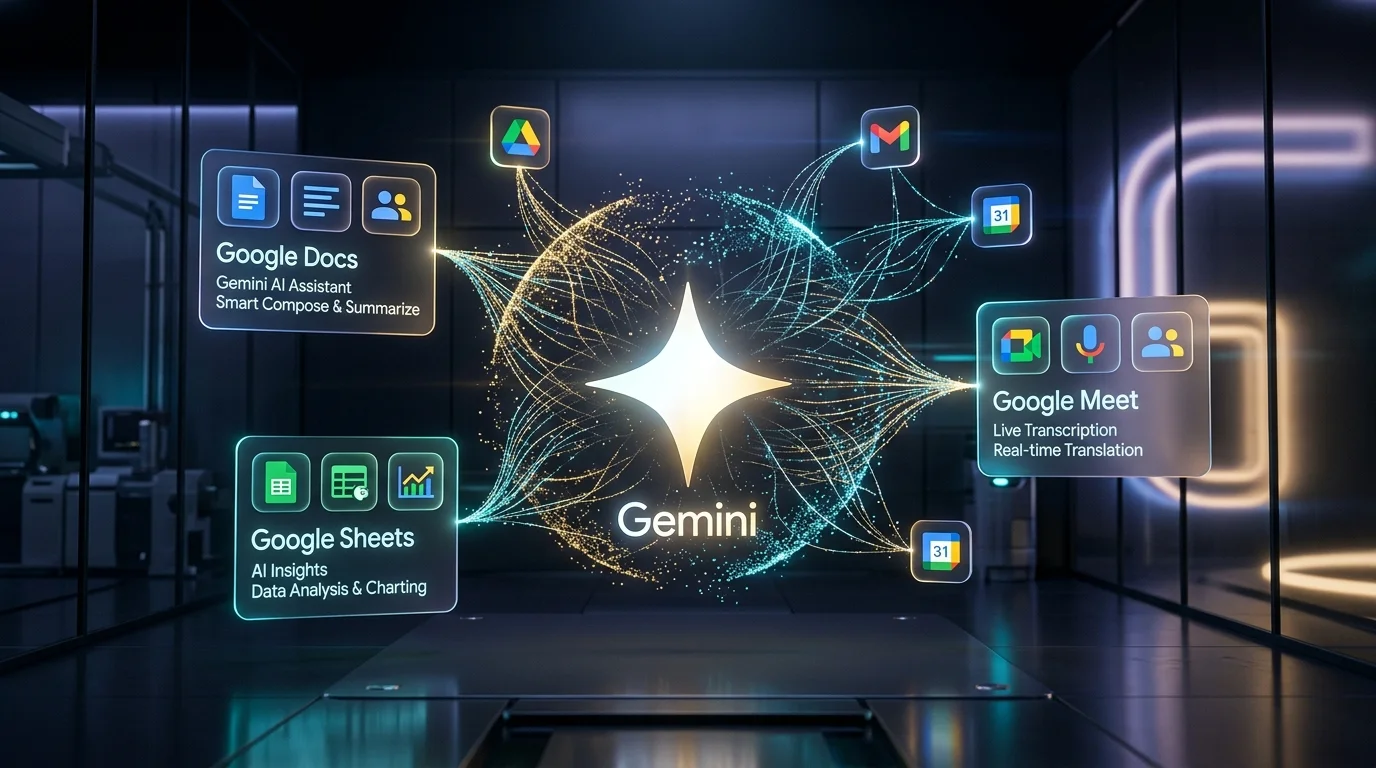
Executive Thesis: The large-scale native integration of Google's Gemini models with massive extended context windows (1 to 2 million tokens) across Google Docs, Sheets, Drive, and Meet decisively accelerates the enterprise transition toward autonomous workflows. By enabling the simultaneous ingestion and cross-correlation of dense tabular datasets, complex technical manuals, and full-length meeting recordings, modern organizations can now produce structured executive deliverables in seconds without maintaining brittle manual ETL pipelines, third-party middleware connectors, or ad-hoc Python and Google Apps Script automations.
For the past two decades, knowledge work, technical product management, and corporate business analysis have been plagued by an invisible yet extraordinarily costly friction:the deep fragmentation of unstructured data trapped across siloed productivity applications. Every critical executive proposal, quarterly budget review, or architectural roadmap historically demanded a grueling sequence of manual, repetitive procedures that drained hundreds of engineering and operational hours:
This widespread operational pattern is, by its strictest computer science definition, ahand-crafted ETL (Extract, Transform, Load) pipeline executed entirely by human cognitive bandwidth. High-paid software engineers and data analysts inadvertently functioned as biological middleware, shuttling information from one file format into another. However, the global rollout ofGemini 1.5 Pro and Gemini Flashnatively embedded into the core fabric of Google Workspace marks an irreversible paradigm shift: the eradication of manual office ETL.
⚡1. The Paradigm Shift: Moving Beyond Word Processors to Autonomous Orchestration
The inaugural wave of generative artificial intelligence inside enterprise office software (2023-2024) was predominantly cosmetic: simple "Help me write" prompts designed to rephrase email drafts in Gmail or suggest basic conditional formatting rules in spreadsheets. While convenient, these early implementations barely moved the needle on enterprise architectural efficiency.
What Google has engineered with this global rollout is a foundational infrastructural evolution. We are no longer interacting with an isolated text generator; we are engaging with apersistent, contextual ambient computing layer. Through the unifiedSide Panelembedded identically across Docs, Sheets, Slides, Drive, and Gmail, the model maintains omniscient situational awareness over the entire enterprise asset graph, strictly gated by the authenticated user's credentials.
Consequently, the model no longer relies on the user to manually copy and paste context into an oversized prompt box. Instead, the architecture dynamically queries theGoogle Workspace Knowledge Graph, traversing relevant email threads in Gmail, slide decks in Slides, archived Google Meet video conferences in Drive, and active financial models in Sheets to resolve sophisticated, multidimensional business inquiries.
🧠2. The 2-Million Token Window: Ending the Fragmentation of Conventional RAG
To fully grasp why this integration represents a quantum leap over earlier corporate tooling, one must examine the severe technical bottleneck that crippled previous enterprise deployments:context length constraints and the architectural fragility of conventional Retrieval-Augmented Generation (RAG).
When working with legacy models restricted to small context windows (4,000 to 32,000 tokens), ingesting an entire corporate project in a single inference pass was mathematically impossible. System architects were forced to build RAG pipelines: partitioning large enterprise documents into small 500-word text chunks, generating vector embeddings, and indexing them in a vector database (such as Pinecone, Milvus, or Qdrant). When a user submitted a query, the system retrieved the top 3 or 5 nearest chunks via cosine similarity and appended them to the LLM prompt.
In high-stakes corporate environments, this legacy RAG pattern broke down catastrophically in two crucial scenarios:
With Gemini 1.5 Pro natively supporting context windows of1 to 2 million tokens(the equivalent of over 1,500 pages of dense technical documentation or up to 11 hours of audio), standard RAG chunking is bypassed. Workspace can load the entire financial ledger, the full legal agreement, and the complete uninterrupted meeting transcript directly into the model's active attention mechanism, executing deep, deterministic cross-correlation without contextual loss.
🏗️3. Technical Architecture: How the Unified Workspace Graph Operates
From a systems engineering perspective, Gemini's enterprise integration is far more sophisticated than a basic REST API proxy attached to a web application frontend. Google has deployed a hybrid microservice architecture meticulously optimized to balance sub-second latency with deep analytical rigor:
@symbol (for instance:"@Cloud_Q3_Budget.xlsx cross-reference our cloud compute expenditures against the scalability targets agreed upon in @Engineering_AllHands_Sept.gdoc").🎯4. Practical Walkthrough: From a Discovery Call in Meet to an Executive Deliverable in Docs
To visualize the magnitude of this operational shift, consider a standard workflow in software consulting and enterprise engineering: drafting aCloud Modernization & Architecture Proposalfollowing a formal discovery session with a prospective enterprise client.
The legacy approach required:
With Gemini's global integration into Workspace, the entire pipeline is consolidated into a single declarative instruction inside Google Docs:
# Prompt executed in the Google Docs Side Panel:
"Analyze the full recording of @Discovery_Fintech_Session.m4a and cross-correlate
the technical requirements articulated by the client's CTO with our infrastructure modeling in @Cloud_Cost_Simulator_2026.xlsx.

Generate a comprehensive, executive-ready technical proposal that includes:
1. Executive summary of existing technical bottlenecks and target performance KPIs (with direct verbatim quotes).
2. Proposed cloud-native microservices architecture on Kubernetes with distributed transactional storage.
3. Comparative infrastructure cost matrix for 100k, 500k, and 2M monthly active users.
4. Risk mitigation matrix and migration phasing aligned with the compliance constraints discussed."
In under 45 seconds, Gemini processes hundreds of thousands of data points across both assets, resolves the cross-dependencies, and populates the Google Doc with a clean, fully articulated 15-page technical blueprint complete with markdown tables, executive takeaways, and verifiable projections.The engineering turnaround cycle drops from an entire workday to minutes of senior human review.
Frequently Asked Questions about Gemini in Google Workspace
📊5. Google Sheets and the Deterministic Dilemma: Probabilistic Inference is Not a Calculator
One of the most persistent concerns among enterprise Chief Financial Officers and Data Engineering leaders when evaluating generative AI is theinherent non-deterministic nature of Large Language Models. A foundational LLM operates by predicting the most statistically probable next token in a sequence. While this probabilistic behavior yields extraordinary results in creative drafting or code synthesis, in corporate accounting or amortized debt modeling, statistical approximation is a recipe for fiscal disaster.
Google resolved this challenge in Sheets through a strict architectural decoupling of semantic reasoning from arithmetic computation:
=SUMPRODUCT(C2:C500, E2:E500) / SUM(E2:E500)) and writes it into the target cell.This dual-engine architecture ensures thathigh-level conceptual reasoning is driven by AI, while mathematical calculation remains 100% deterministic, reproducible, and compliant with external financial audit standards.
⚔️6. Technical Comparison: Google Workspace with Gemini vs. Microsoft 365 Copilot
The decisive battle for control of the enterprise operating system is currently unfolding between Google and Microsoft. Both tech titans provide productivity suites supercharged by frontier models, but their underlying systems architectures reveal stark philosophical differences that every CTO and enterprise architect must evaluate:
| Technical Dimension | Google Workspace with Gemini | Microsoft 365 Copilot |
|---|---|---|
| Maximum Context Window | Up to 2,000,000 tokens (Gemini 1.5 Pro) | 128,000 tokens (GPT-4o via Azure OpenAI) |
| Native Multimodal Processing | Direct native ingestion of audio, Google Meet video streams, tabular data, and massive PDFs without separate transcription layers. | Dependent on asynchronous subsidiary services (Teams Transcript APIs) before LLM prompt assembly. |
| Client Architecture | 100% Web-First and real-time collaborative. Zero legacy Win32 or desktop client dependencies. | Hybrid (Web + Heavy legacy Win32/macOS desktop binaries with complex OneDrive synchronization). |
| Retrieval Strategy (RAG) | Direct active-attention ingestion for large documents; secondary RAG for global Drive index. | Intensive chunked RAG over Microsoft Graph semantic index. |
| Governance & Compliance | Strict Google Cloud enterprise tenant boundaries; zero customer data used for base model training. | Tight integration with Microsoft Purview, Azure compliance boundaries, and tenant isolation. |
While Microsoft leverages its immense legacy footprint across Fortune 500 banks and traditional enterprises, Google's technical advantage lies in its modern, cloud-native web architecture and the unprecedented ability to digest raw, unchunked enterprise assets within Gemini's massive context window.
🛡️7. Critical Security Vectors: Governance, DLP, and Data Poisoning Risks
Despite the immense operational leap forward, introducing deep generative intelligence across corporate files creates novel security attack surfaces that every Chief Information Security Officer (CISO) must proactively mitigate:
Recommended Deep Dives on Infrastructure & Systems
Transform an affordable VPS into your private PaaS to deploy internal APIs and automations without recurring SaaS markups.
Industry-standard free architectures to streamline user experience and infrastructure security during early growth.
Comprehensive architectural trade-offs to optimize computational cost and server latency in production.
🚀8. Strategic Outlook: The Redefined Role of the Technical Leader
The worldwide deployment of Gemini across Google Workspace represents far more than an incremental user interface enhancement; it marks the formal inception of an ambient enterprise operating system. The era in which senior software engineers, product managers, and business analysts spent half their workdays downloading CSVs, wrangling pivot tables, and compiling redundant status documents is conclusively drawing to a close.
Professional value in modern organizations is rapidly pivoting away from manual pipeline execution towardhigh-precision prompt engineering, rigorous data governance architecture, and the critical validation of AI-synthesized business hypotheses. Engineering and operational teams that lean into this paradigm of autonomous orchestration will not only operate at an order of magnitude higher velocity, but will transform their passive enterprise data into the most decisive competitive moat of the next decade.