
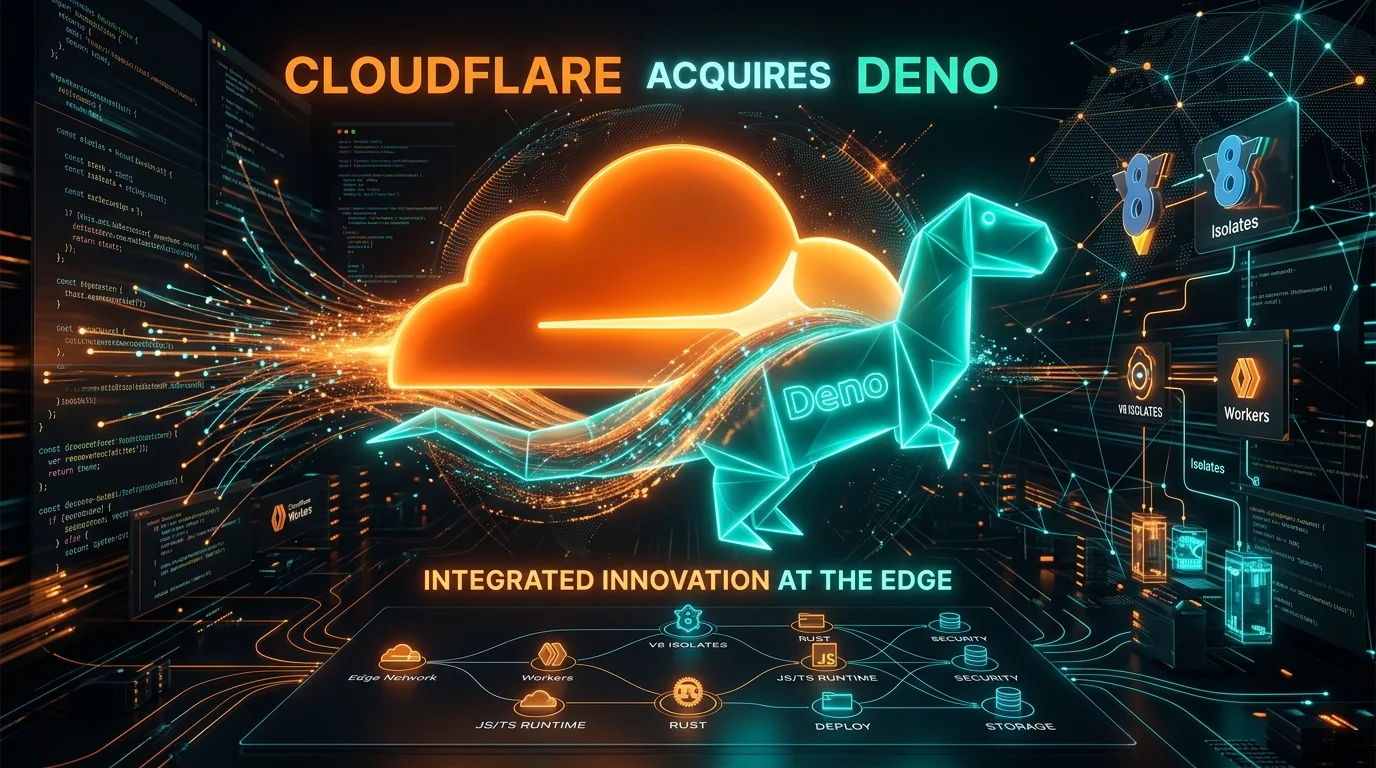
Executive Thesis: The official announcement of Cloudflare acquiring Deno on October 9, 2026 marks the definitive conclusion to the fragmentation of JavaScript execution environments. By bringing in Ryan Dahl, Bert Belder, and the entire engineering roster to merge their flagship open source project celld into workerd, Cloudflare permanently dismantles the historic critique of vendor lock-in by providing first-class self-hosting for Workers and Durable Objects. Concurrently, it reshapes the economics of open source by sunsetting Deno Deploy within six months and providing one year of extended maintenance for the standalone Deno CLI before freezing official development.
⚡Introduction: The Breakthrough News and Why It Matters Beyond JavaScript
For more than half a decade, the global software engineering community regarded Deno as the ideological benchmark for how a modern runtime should look and feel. Founded in 2018 by Ryan Dahl, the creator of Node.js, Deno was conceived to systematically resolve the core architectural flaws he acknowledged during his landmark Berlin keynote: the chaotic bloat of thenode_modulesfolder, the lack of built-in TypeScript execution without complex build pipelines, the absence of an explicit security sandbox, and the proliferation of proprietary server APIs instead of open W3C browser standards.
On October 9, 2026, the technology landscape experienced a seismic shift:Cloudflare officially acquired Deno. The entire Deno engineering team has joined Cloudflare to spearhead the evolution of the Workers programming model. Concurrently, a rigorous operational roadmap was established: the commercial hosted platform Deno Deploy will shut down within six months, while the standalone Deno CLI runtime will receive twelve months of maintenance and security updates before official development permanently halts.
This transaction reaches far beyond language syntax preferences. It highlights the unforgiving financial reality of running venture-backed open source runtimes, validates the architectural superiority of V8 micro-isolates over heavyweight virtualization, and fundamentally redraws the boundaries of tech sovereignty across distributed cloud systems.
🧩1. What Is Truly Being Acquired: The Engineering Roster, Deep Expertise, and celld
In high-profile corporate tech transactions, a significant gap frequently exists between public perception and the foundational engineering assets that drive capital allocation. In this deal, Cloudflare did not pay for branding or GitHub stars; it acquired three critical strategic pillars that unlock its biggest enterprise growth barrier:
The engineering crown jewel: celld and universal self-hosting.The single biggest objection preventing enterprise organizations from committing fully to Cloudflare Workers was vendor lock-in anxiety. Unlike Node.js, where a containerized workload can run across AWS, Google Cloud, or on-premise hardware without code changes, applications built on Workers and Durable Objects were tied to Cloudflare's proprietary network. To address this friction, the Deno team engineeredcelld, an open source project enabling the Cloudflare Workers and Durable Objects programming model to run seamlessly across any bare-metal server, private data center, or Kubernetes cluster. By merging celld intoworkerd, Cloudflare turns self-hosting into an officially supported, first-class capability.
Mastery of Google V8 and Rust systems.Co-founders Ryan Dahl and Bert Belder possess world-class expertise in the internals of Google's V8 engine and its interoperability with low-level Rust and C++ systems. Maintaining core libraries such asrusty_v8requires deep specialized knowledge that very few teams globally command. Cloudflare secures the pioneers who defined runtime engineering for the modern web.
📉2. Deno's Strategic Pivot: Sunset of the Standalone Runtime and Deno Deploy Shutdown
Understanding how Deno reached this turning point requires examining the commercial economics of software runtimes over the past decade. Deno Inc. raised over 25 million dollars in venture capital from prominent Silicon Valley funds. The commercial monetization hypothesis was straightforward: build an exceptional free CLI runtime to attract developers, and capture downstream revenue throughDeno Deploy, a globally distributed edge hosting platform charging for requests, compute duration, and persistent key-value storage with Deno KV.
However, the serverless cloud landscape proved fiercely competitive. Cloudflare possessed an existing global network spanning over 300 cities, offering generous free tiers and aggressive pricing that a standalone startup could not match without dedicated fiber backbones. Concurrently, Vercel captured enterprise frontends via Next.js dominance, while AWS Lambda remained the entrenched default for legacy enterprises.
| Ecosystem Component | Timeline | Immediate Operational Impact | Long-Term Transition Path |
|---|---|---|---|
| Deno Deploy | 6 Months | Total shutdown of managed hosting servers | Mandatory customer migration to Cloudflare Workers |
| Deno CLI / Runtime | 12 Months | Monthly security patches and bug fixes | End of official development; community fork path |
| JSR (JavaScript Registry) | Permanent | Infrastructure migrated to Cloudflare edge | Active operation as universal modern package registry |
| celld / workerd | Active | Deep merge into open source workerd repo | Official self-hosting support for Workers & Objects |
| rusty_v8 | Permanent | Continued engineering stewardship at Cloudflare | Maintained Rust bindings for the Google V8 engine |
The preservation of JSR is an essential relief for the developer ecosystem. The modern JavaScript Registry (JSR), designed by Deno to publish pure TypeScript modules with automated documentation and type inference, will not be abandoned. Cloudflare is absorbing all server, bandwidth, and storage costs, ensuring that thousands of modern packages will remain accessible without broken dependencies.
🌐3. Cloudflare Wants More Than Serving Web Pages: Tools, Execution, and Edge Compute
Categorizing Cloudflare as merely a content delivery network (CDN) or DDoS mitigation provider ignores the massive architectural expansion achieved over the past five years. With R2 for zero-egress object storage, D1 for distributed relational SQLite data, Hyperdrive for connection pooling acceleration, and Vectorize for embedding indexes in AI workloads, Cloudflare has assembled a comprehensive modern cloud platform.
The missing element was an uncompromised local developer experience (DX) and an airtight solution to portability concerns. With Deno's tooling expertise and celld integration, engineers can develop locally using standard web primitives and seamlessly deploy to Cloudflare's edge or run inside private on-premise infrastructure under rigorous regulatory constraints such as HIPAA or GDPR.
// Universal WinterCG standard implementation
// Fully portable across Cloudflare Workers, workerd, and self-hosted celld

interface Env {
  STORAGE_BUCKET: R2Bucket;
  APP_SECRET: string;
}

export default {
  async fetch(request: Request, env: Env, ctx: ExecutionContext): Promise<Response> {
    const url = new URL(request.url);

    // Standard routing using Web APIs
    if (url.pathname === "/api/v1/health") {
      return Response.json({
        status: "operational",
        runtime: "workerd-celld-unified",
        region: request.headers.get("cf-ipcountry") || "local-datacenter",
        timestamp: new Date().toISOString()
      }, {
        headers: {
          "Cache-Control": "public, max-age=60, s-maxage=300",
          "X-Content-Type-Options": "nosniff"
        }
      });
    }

    // Secure payload processing with Web Crypto API
    if (request.method === "POST" && url.pathname === "/api/v1/telemetry") {
      const payload = await request.json();
      const rawData = new TextEncoder().encode(JSON.stringify(payload));
      const digestBuffer = await crypto.subtle.digest("SHA-256", rawData);
      const hashHex = Array.from(new Uint8Array(digestBuffer))
        .map(b => b.toString(16).padStart(2, "0"))
        .join("");

      return Response.json({ accepted: true, hash: hashHex });
    }

    return new Response("Not Found", { status: 404 });
  }
};🌍4. The Impact on the Web Ecosystem: Strapi, Directus, Payload, Astro, Vite, and Next.js
The consolidation of edge runtime architecture around web standards produces immediate ripples across frontend frameworks and headless content management systems:
Astro and Vite: Natural Beneficiaries.Astro was built from inception around standard web adapters. Unifying Deno's tooling with Cloudflare provides Astro developers with unmatched stability and velocity, allowing teams to deliver static and server-rendered applications without encountering awkward polyfills.
Payload CMS: Ideal Modern Alignment.Payload CMS, natively built with Next.js and TypeScript, benefits immensely from serverless SQL adapters and cloud storage. Running Next.js backends directly on workerd with D1 or Hyperdrive-accelerated PostgreSQL makes full headless stacks deployable without managing standard Linux operating system images.
Directus and Strapi: The Evolution Challenge.Both Strapi and Directus were historically designed as persistent Node.js servers, relying heavily on local filesystem plugins and persistent connection pools. The emergence of celld creates a compelling avenue: allowing enterprise teams to self-host lightweight headless CMS instances without the CPU and memory footprint of traditional container orchestration.
Next.js and Vercel's Competitive Landscape.Next.js remains the enterprise corporate leader. However, this acquisition weakens Vercel's exclusive moat. With Cloudflare expanding its native compatibility and offering on-premise portability through celld, enterprise architects now have a formidable alternative to slash high bandwidth and edge execution bills.
⚖️5. Open Source and Vendor Dependence: Guarantees, Trade-offs, and Risks
Every acquisition of an open source flagship by a publicly traded cloud conglomerate demands rigorous scrutiny. Tech history is replete with mergers where open source independence was promised, only to be dismantled once intellectual property was absorbed.
On the positive side, integrating celld into workerd addresses the single most valid critique of Cloudflare: runtime lock-in. By releasing the execution core under permissive open source terms (Apache 2.0) and empowering developers to run Workers outside proprietary data centers, Cloudflare builds an open posture that outshines AWS Lambda's closed runtime engine.
Conversely, market concentration poses tangible hazards. When a single vendor controls authoritative DNS, DDoS security, SSL certificates, edge routing, distributed databases, package registries (JSR), and runtime execution, systemic risk escalates. Global routing anomalies or policy modifications directly impact millions of software businesses.
🛠️6. Strategic Playbook for Engineering Teams: Portability, Costs, and Migrations
For Chief Technology Officers, cloud architects, and DevOps leads, this consolidation requires strategic tactical steps over upcoming planning cycles:
1. Audit production workloads on Deno Deploy.If your organization relies on webhooks or microservices running on Deno Deploy, the six-month countdown has begun. Prepare migration plans to Cloudflare Workers. Core business logic using Fetch APIs will migrate smoothly, but Deno KV persistence schemas must be transitioned to Cloudflare D1 or KV.
2. Re-evaluate standalone Deno in local containerized workflows.If Deno was chosen as the default CLI for Docker containers or automation scripts, prepare for the eventual conclusion of official maintenance in twelve months. For standalone servers, Bun stands as the primary alternative offering superior speed and npm compatibility, while Node.js 22 and 24 offer native TypeScript stripping out of the box.
3. Commit strictly to WinterCG standards.The definitive lesson of this acquisition is that coupling code to runtime-specific APIs is an expensive architectural hazard. Ensure all new backend code relies exclusively on universal Web standards: Request, Response, Headers, URL, TextEncoder, Web Crypto, and Streams. WinterCG-compliant code runs seamlessly across Cloudflare Workers, Node.js, Bun, celld, and browsers.
4. Benchmark edge compute economics carefully.The pricing model of Cloudflare Workers based on CPU execution milliseconds and request counts provides immense savings for high-concurrency burst workloads. However, continuous long-running background computing remains significantly more cost-effective on dedicated servers or self-hosted environments via celld.
🏁Conclusion: Deno Survives by Becoming the Engine of the Modern Cloud
The acquisition of Deno does not mark the demise of its ideals; it solidifies their victory across the broader web infrastructure. Ryan Dahl reshaped modern software engineering twice: first in 2009 by creating Node.js and introducing non-blocking event-driven architectures to the mainstream, and again in 2018 by pushing the entire ecosystem toward strict TypeScript, default security, and universal web standards with Deno.
The closure of Deno as a standalone venture demonstrates that lasting infrastructure value no longer resides in the binary you install on a terminal, but in the distributed fabric that executes it globally with microsecond latency. Through celld and workerd, Cloudflare not only wins the runtime battle; it establishes the foundation upon which the next era of resilient, portable, and sovereign web applications will be built.
Strategic Recommendation: When architecting new software systems, never build strictly for a single hosting vendor. Design your services using standard WinterCG Web APIs and strict TypeScript. This guarantees that your platform runs smoothly on Cloudflare Workers today and can be self-hosted on any private cloud tomorrow with celld, without paying the costly price of technology lock-in.
Recommended Articles on Cloud & Infrastructure Architecture
Technical analysis of the Stainless acquisition and Cloudflare's release of Forge to compile sovereign, edge-ready SDKs.
Learn how to turn an affordable VPS into your private Vercel-like platform with Git push deployments and automated SSL.
The strategic engineering alliance between DeepSeek and Huawei to compile and optimize AI models on Ascend processors.