
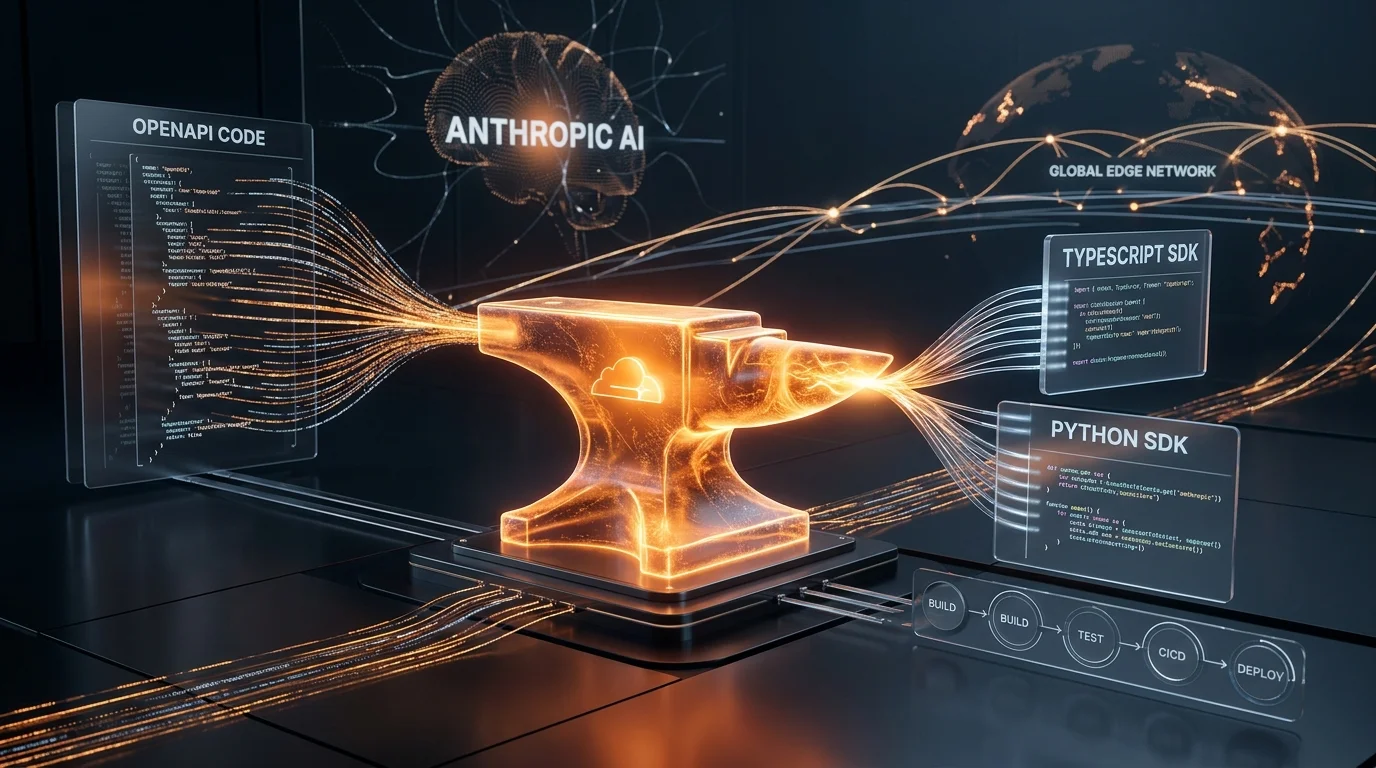
Executive Thesis: The sudden acquisition of Stainless —the de facto standard used by OpenAI, Cloudflare, and premier AI companies to compile hyper-ergonomic SDKs from OpenAPI specifications— by Anthropic, accompanied by the abrupt shutdown of its public service, has sent shockwaves through platform engineering teams worldwide. In response to this imminent supply-chain vendor lock-in risk, Cloudflare has open-sourced Forge: an edge-first, zero-bloat SDK compiler engineered to execute sovereignly within self-hosted CI/CD pipelines. Concurrently, Anthropic's latest Threat Intelligence Report documents how autonomous offensive agent frameworks (such as PentAGI) are now actively automating the entire cyber kill chain against exposed endpoints, transforming strictly typed SDKs and runtime schema validation into mandatory first-line infrastructure defenses.
In modern cloud-native architectures and distributed microservice ecosystems, the Application Programming Interface (API) represents the sacred operational contract governing how distributed software components communicate. Yet for over a decade, platform engineering teams have wrestled with a deeply painful workflow chasm:the massive engineering gap between maintaining an OpenAPI/Swagger contract and reliably distributing elegant, strongly typed, idiomatic client libraries (SDKs) in TypeScript, Python, or Go.
Legacy open-source code generators such asopenapi-generatororswagger-codegenhistorically output rigid, verbose, and poorly maintainable boilerplate code laden with outdated third-party dependencies and clunky developer ergonomics. Against this backdrop emergedStainless, an elite startup that transformed the developer tooling market by delivering a managed platform capable of compiling OpenAPI 3.0 and 3.1 schemas into client libraries indistinguishable from hand-crafted code written by senior software engineers: native promise chains, intelligent automatic pagination, exponential backoff retries, and rock-solid TypeScript type inference.
Virtually the entire vanguard of the modern AI and devtools ecosystem —from OpenAI's official SDKs to Cloudflare, Resend, and Anthropic itself— entrusted the automated generation and distribution of their mission-critical SDKs to Stainless's proprietary infrastructure. Today, that era of convenient reliance has abruptly ended.
🚨1. The Stainless Acquisition: The Reality of Supply-Chain Vendor Lock-in
The formal confirmation thatAnthropic has acquired Stainless and immediately shuttered public signups and external customer onboardingrepresents an urgent cautionary tale for every Chief Technology Officer (CTO) and DevOps lead:outsourcing a foundational stage of your software compilation and distribution pipeline to a single proprietary SaaS vendor is an existential operational hazard.
By absorbing Stainless, Anthropic successfully insources the planet's premier SDK engineering talent to supercharge its Claude developer ecosystem. However, it simultaneously strands hundreds of high-growth technology companies in a precarious architectural bind. Platform teams whose continuous integration and delivery (CI/CD) pipelines relied on automated webhook calls to Stainless's closed APIs to publish packages to npm, PyPI, or crates.io were instantly confronted with an orphaned, deprecated workflow controlled by an industry competitor.
This aggressive consolidation wave within the artificial intelligence sector demonstrates that developer tooling is no longer mere developer convenience; it isstrategic geopolitical leverage within corporate software infrastructure. The entity that controls the client code generation toolchain decisively controls the speed and friction with which millions of software engineers integrate or abandon an API in production.
⚒️2. Cloudflare's Strategic Countermeasure: Open-Sourcing Forge
As one of the world's most prolific consumers of Stainless across hundreds of edge networking endpoints, Cloudflare could not afford to remain operationally beholden to a rival AI enterprise. Rather than seeking a private alternative, Cloudflare took decisive action:open-sourcing 'Forge', a next-generation SDK compiler designed to restore technological sovereignty to developer platform teams.
Unlike legacy code generators architected for monolithic server environments, Forge was designed from day one around the core tenets of modern edge computing and the WinterCG standard:
axiosornode-fetch. Generated clients rely exclusively on standard web primitives:fetch,Request,Response, andReadableStream, slashing bundle sizes by more than 70% compared to conventional generated clients.anyOf,oneOf, and recursive references, entirely eliminating looseanytypes that compromise compile-time guarantees.⚙️3. Systems Architecture: Automated DevOps Pipelines with Cloudflare Forge
For site reliability engineers (SRE) and DevOps practitioners, the emergence of Forge enables the implementation of a completely automated API contract lifecycle governed by the principles ofGitOps and Contract-as-Code.
The operational workflow is straightforward and resilient: whenever backend developers modify service definitions (in NestJS, FastAPI, Go Gin, or Laravel), the primary CI pipeline generates an updatedopenapi.jsonartifact. Instead of dispatching a webhook to an external SaaS compiler, the CI runner invokes the Forge CLI locally, executes rigorous unit and synthetic integration tests against the freshly minted client libraries, and publishes versioned packages across registries automatically.
Below is an enterprise-gradeGitHub Actionsworkflow demonstrating this autonomous contract-to-SDK pipeline in action:
# .github/workflows/generate-sdk.yml
name: API Contract & SDK Distribution Pipeline

on:
  push:
    branches: [ main ]
    paths:
      - 'specs/openapi.json'
      - 'specs/openapi.yaml'

jobs:
  build-and-publish-sdks:
    runs-on: ubuntu-latest
    steps:
      - name: Checkout Code Repository
        uses: actions/checkout@v4

      - name: Setup Node.js Runtime
        uses: actions/setup-node@v4
        with:
          node-version: 22
          registry-url: 'https://registry.npmjs.org'

      - name: Install Cloudflare Forge Compiler
        run: npm install -g @cloudflare/forge

      - name: Validate OpenAPI Schema Integrity
        run: npx @redocly/cli lint specs/openapi.json

      - name: Compile Edge-Optimized TypeScript SDK
        run: |
          forge generate             --input specs/openapi.json             --target typescript             --output ./sdks/typescript             --package-name @my-org/api-client             --strict-null-checks

      - name: Execute Typechecks and Synthetic Tests
        run: |
          cd ./sdks/typescript
          npm install
          npm run test
          npm run build

      - name: Automated Semantic Release to NPM
        env:
          NODE_AUTH_TOKEN: ${{ secrets.NPM_AUTOMATION_TOKEN }}
        run: |
          cd ./sdks/typescript
          npm publish --access public --provenance
This automated pipeline guarantees absolute contract parity across consumer services:if a database migration or controller refactoring alters a field type, the SDK build breaks in CI before breaking downstream client integrations in production.
⚖️4. Architecture Matrix: Stainless vs. Cloudflare Forge vs. Legacy OpenAPI Generator
To evaluate these toolchains in architecture review boards, platform engineers must weigh key technical trade-offs across all three approaches:
| Architectural Vector | Stainless (Anthropic) | Cloudflare Forge (OSS) | Legacy OpenAPI Generator |
|---|---|---|---|
| Deployment Topology | Closed proprietary SaaS (public signups frozen post-acquisition) | 100% Open Source (Sovereign local CLI running in self-hosted CI/CD) | Open Source (Java / Docker runtime container) |
| Edge Runtime Native Support | High (modern Fetch and Node compatible) | First-class native (Cloudflare Workers, Deno, Bun, WinterCG standard) | Poor (frequently bundles legacy Node.js core modules like http) |
| Dependency Footprint | Ultra lightweight (~15 KB compressed) | Zero external dependencies (Clean, fully tree-shakeable) | Bloated (pulls in redundant utility packages and heavy HTTP clients) |
| TypeScript Type Precision | Industry benchmark | Advanced (Discriminated unions, strict generics, zero-any policy) | Moderate (frequent typing collapses on polymorphic schemas) |
| Supply-Chain Risk | Critical (owned by external AI competitor) | Zero (Permissive license, forkable, auditable on GitHub) | Low (broad community, albeit slow development velocity) |
Frequently Asked Questions about Cloudflare Forge and SDK Toolchains
🛡️5. The Cybersecurity Frontier: Autonomous Threat Agents (PentAGI) Demand Hardened SDKs
Coinciding with the Stainless acquisition, Anthropic's cybersecurity research division released itsThreat Intelligence Report for late September 2026. The findings establish an urgent technological reality:API contract integrity and client ergonomics are no longer merely developer productivity enhancements—they are critical lines of defense against automated cyber warfare.
Anthropic's threat researchers documented a dramatic structural shift:sophisticated adversaries are now deploying autonomous offensive agent frameworks (such as PentAGI and specialized offensive LLM scaffolds) to execute end-to-end attacks across the Cyber Kill Chain without human intervention:
Under this asymmetric threat landscape,interacting with APIs through untyped, raw HTTP fetch requests is an unacceptable architectural risk. By compiling SDKs through a rigorous compiler like Forge, platform engineers enforce strict schema validation at the edge: payloads containing unexpected properties or type mismatches are rejected before they ever reach core application servers.
📋6. Platform Engineering Action Plan: Future-Proofing Your API Infrastructure
To navigate the accelerating consolidation of developer toolchains, platform and DevOps leaders should execute four strategic imperatives:
400 Bad Requestresponse.Recommended Deep Dives on Infrastructure & Systems
Transform an affordable VPS into your private PaaS to deploy internal APIs and automations without recurring SaaS markups.
Comprehensive architectural trade-offs to optimize computational cost and server latency in production.
Technical analysis of how massive context models eliminate manual office data processing across enterprise applications.
🚀7. Conclusion: Sovereign Toolchains in the Era of AI Consolidation
The unfolding saga of Stainless, Anthropic, and Cloudflare Forge serves as a powerful reminder of an immutable law of software systems:the extreme convenience of closed developer platforms almost always carries an eventual hidden cost in architectural sovereignty.
Cloudflare's prompt open-sourcing of Forge highlights the enduring resilience of the open-source movement in defending against emerging vertical monopolies in the artificial intelligence landscape. DevOps and platform teams that build sovereign, contract-driven pipelines powered by open compilers will not only remain insulated from corporate acquisitions, but will possess the hardened, edge-native infrastructure required to thrive in an era of autonomous computing.