
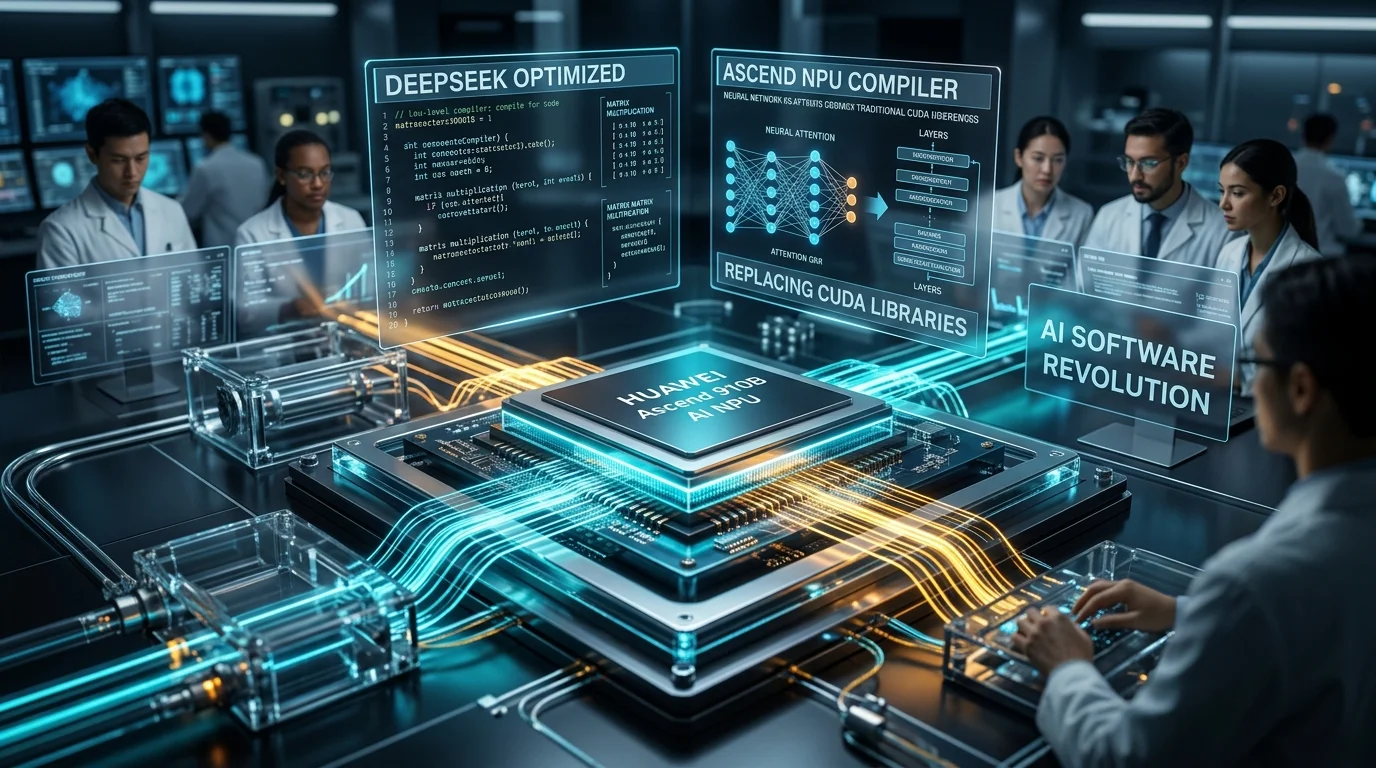
Executive Thesis: Nvidia's formidable defensive moat has never resided solely in the raw silicon of its H100 or B200 GPUs, but rather in its deeply entrenched proprietary software ecosystem: CUDA, cuDNN, TensorRT, and low-level distributed communication primitives. The strategic engineering partnership between DeepSeek and Huawei to open-source specialized compilers, high-performance attention kernels, and seamless PyTorch interoperability layers tailored to Huawei Ascend NPU processors marks a defining turning point in AI hardware geopolitics. For the first time, a frontier AI research lab is co-designing low-level compilers and distributed training toolchains for non-Western silicon, establishing a viable, production-ready alternative that meaningfully erodes the global dependence on Nvidia's CUDA architecture.
For the past fifteen years, the accelerated computing and deep learning sectors have operated under a virtually unquestioned industry dogma:to train and serve frontier large language models at enterprise scale, Nvidia is the only production-grade path. This architectural reality propelled Jensen Huang's firm into one of the most valuable corporations on Earth, while simultaneously creating unprecedented market concentration and acute supply-chain vulnerabilities for global technology companies and sovereign compute initiatives alike.
Major semiconductor titans (including AMD with its ROCm initiative, Intel with its Gaudi accelerators, and Google with proprietary Cloud TPUs) repeatedly sought to challenge this monopoly by engineering silicon with matching or superior theoretical TFLOPS. Yet virtually every contender collided with the exact same invisible fortress:the proprietary software wall of CUDA. Successfully scaling a distributed training cluster across tens of thousands of accelerators rarely depends on theoretical silicon compute density alone; it hinges on millions of lines of hyper-optimized assembly kernels, sub-microsecond inter-node collective communications (NCCL), memory virtualization engines, and specialized flash-attention kernels written exclusively for Nvidia's Streaming Multiprocessor (SM) memory hierarchy.
The announcement thatDeepSeek—the AI research laboratory that disrupted Silicon Valley through its groundbreaking architectural efficiency and sparse Mixture-of-Experts (MoE) designs— has entered into an intensive co-development partnership withHuaweito release an open-source compiler toolchain engineered for theAscend 910B and 910Cprocessors shatters this foundational bottleneck, permanently altering the global AI infrastructure landscape.
🏰1. The True Moat: Why Raw Silicon Is Powerless Without the Software Stack
For software engineers and infrastructure architects outside the specialized realm of low-level compiler optimization, it is easy to conflate Nvidia's competitive moat with physical silicon fabrication. In high-performance distributed machine learning, however, physical hardware represents barely 30% of the operational equation; the remaining 70% is governed entirely by the software compilation substrate:
The collaborative engineering initiative between DeepSeek and Huawei directly dismantles this dependency:bypassing the need for CUDA by establishing an open-source compilation and execution layer engineered natively on top of Huawei's CANN architecture.
⚙️2. Architectural Deep Dive: Huawei CANN Meets DeepSeek's Algorithmic Innovations
Huawei's artificial intelligence computing substrate is built uponCANN (Compute Architecture for Neural Networks)and its proprietaryDaVinci Coremicroarchitecture powering the Ascend processor series. While Nvidia GPUs execute matrix math via Tensor Cores nested alongside general SIMT streaming shaders, Ascend NPUs leverage a dedicated 3D Cube compute matrix engine specifically hardwired for ultra-dense tensor multiplication.
Historically, developer adoption of CANN was constrained by the scarcity of engineers fluent in Ascend C and the relative immaturity of its profiling toolchains. DeepSeek's systems engineering expertise addresses this challenge with surgical precision:
torch_npuacceleration plugin, machine learning engineers can execute existing PyTorch workloads by simply toggling the target runtime device fromcudatonpu, delegating computational graph fusion and instruction scheduling to the open-source CANN backend.💻3. Production Code Walkthrough: Transitioning from CUDA to Ascend NPU in PyTorch
To illustrate the practical developer experience of this emerging toolchain, consider how machine learning engineers interface with Huawei Ascend NPU clusters using DeepSeek's optimized runtime compared to standard Nvidia CUDA environments:
# Distributed Training & Inference Pipeline: Nvidia CUDA vs. Huawei Ascend NPU

import os
import torch

# 1. Device Dispatch and Collective Communication Backend Setup
USE_ASCEND_NPU = os.getenv("BACKEND_HARDWARE", "NPU") == "NPU"

if USE_ASCEND_NPU:
    # Import Huawei Ascend Acceleration Plugin (CANN 8.0 Integration)
    import torch_npu
    from torch_npu.contrib import transfer_to_npu

    device = torch.device("npu:0")
    # Huawei Collective Communication Library (NCCL equivalent)
    dist_backend = "hccl"
    print(f"[*] Initialized Huawei Ascend NPU via CANN: {torch.npu.get_device_name(0)}")
else:
    device = torch.device("cuda:0")
    dist_backend = "nccl"
    print(f"[*] Initialized Nvidia GPU via CUDA: {torch.cuda.get_device_name(0)}")

# 2. Distributed Process Group Initialization (Tensor & Expert Parallelism)
torch.distributed.init_process_group(
    backend=dist_backend,
    init_method="env://"
)

# 3. High-Performance DeepSeek MLA Attention Layer
class DeepSeekAttentionLayer(torch.nn.Module):
    def __init__(self, dim, num_heads, kv_latent_dim):
        super().__init__()
        self.dim = dim
        self.num_heads = num_heads
        self.kv_latent_dim = kv_latent_dim
        self.q_proj = torch.nn.Linear(dim, dim, bias=False)
        self.kv_compress = torch.nn.Linear(dim, kv_latent_dim, bias=False)

    def forward(self, x):
        # On Ascend NPUs, the compiler automatically fuses and schedules
        # matrix multiplication across DaVinci 3D Cube cores without manual assembly rewrites
        q = self.q_proj(x)
        compressed_kv = self.kv_compress(x)
        return torch_npu.npu_fused_attention(q, compressed_kv) if USE_ASCEND_NPU else torch.nn.functional.scaled_dot_product_attention(q, compressed_kv, compressed_kv)
Through automatic graph rewrites (transfer_to_npu) and drop-in HCCL collective communications,over 95% of existing open-source training and inference frameworks (including vLLM, SGLang, and Megatron-LM) can seamlessly transition to Ascend clusters without rewriting model architecture logic.
⚖️4. Architecture Comparison: Nvidia CUDA Stack vs. Huawei Ascend + DeepSeek Stack
The table below provides an exhaustive systems-level evaluation comparing the legacy proprietary Nvidia stack with the open-source Huawei Ascend and DeepSeek ecosystem:
| Architectural Vector | Nvidia Ecosystem (H100 / B200) | Huawei Ascend + DeepSeek Stack (910B/C) |
|---|---|---|
| Underlying Software Substrate | CUDA, cuDNN, TensorRT (Closed proprietary runtime) | CANN 8.0 + DeepSeek Open Toolchain (Open, extensible stack) |
| Inter-Node Fabric | NVLink 4/5 (900 - 1800 GB/s bidirectional) + NVSwitch | HCCS (392 - 784 GB/s) + RoCE v2 400G/800G Ethernet |
| Collective Communications | NCCL (Nvidia Collective Communications Library) | HCCL (Huawei Collective Communication Library) |
| MoE Architecture Optimization | Megatron-LM, DeepSpeed (General-purpose kernel scheduling) | Co-designed custom Ascend C kernels for DeepSeekMoE & MLA |
| Capital Expenditure & Availability | Prohibitive ($30k - $40k per accelerator) with multi-month lead times | 40% to 60% lower hardware acquisition and cloud hosting costs |
| Geopolitical Supply Chain Risk | Subject to unilateral US BIS export controls and licensing bans | Completely sovereign end-to-end semiconductor supply chain |
Frequently Asked Questions about DeepSeek, Huawei Ascend, and the Post-CUDA Era
🌐5. Geopolitical Repercussions: The Reshaping of the Global Semiconductor Landscape
The engineering alliance between DeepSeek and Huawei extends far beyond commercial developer collaboration; it marks one of the most consequential geopolitical developments in modern technology history:
💡6. Strategic Takeaways for Machine Learning Architects and DevOps Leaders
For engineering directors and platform architects designing next-generation AI infrastructure in 2026, the DeepSeek-Huawei collaboration offers three indispensable architectural lessons:
torch.compile, and multi-backend inference runtimes (such as vLLM and SGLang).Recommended Reading on Cloud, AI, and Systems Engineering
How open-source compilation toolchains protect software engineering sovereignty from proprietary platform closures.
Technical analysis of how massive context windows eliminate manual data ETL pipelines across enterprise organizations.
Practical strategies for cost-effective self-hosted infrastructure and complete operational sovereignty.
🚀7. Conclusion: The Heterogeneous Future of Artificial Intelligence
The engineering alliance between DeepSeek and Huawei is far more than a localized corporate agreement; it is the catalyst accelerating the post-CUDA era in high-performance computing. For nearly two decades, the tech industry assumed that Nvidia's software moat was an impenetrable fortress that would guarantee near-total market control indefinitely.
Today, the convergence of algorithmically superior neural architectures with co-designed, open-source compilers engineered for alternative silicon proves that the future of artificial intelligence will be heterogeneous, modular, and globally distributed. For the international engineering community, this evolution is overwhelmingly positive: intensifying competitive pressure, lowering compute costs per token, and above all, restoring the freedom to innovate without requesting permission from a single silicon monopoly.